
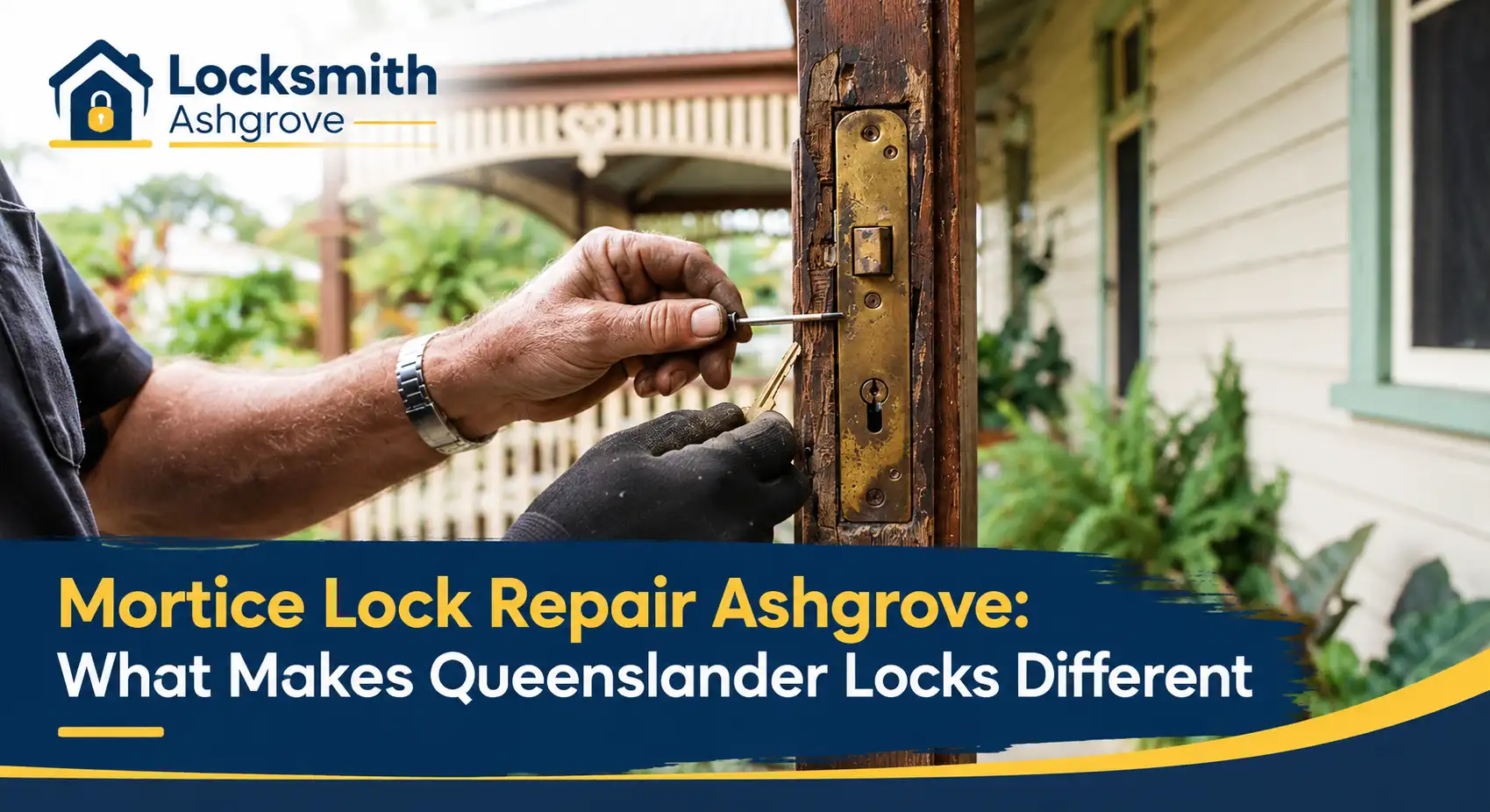
Why Queenslander Homes Need a Different Kind of Locksmith Knowledge
If you own or rent a classic Queenslander in Ashgrove, there’s a good chance your front door still has its original mortice lock — a style of lock that’s largely disappeared from modern homes but remains common across Brisbane’s older suburbs. Anyone searching for mortice lock repair Ashgrove wide is usually dealing with exactly this situation: a beautiful, character-filled home with hardware that a general locksmith might not be properly equipped to handle.
Mortice locks aren’t simply an older version of the cylinder locks found in most modern homes. They’re a genuinely different mechanism, built into the door itself rather than mounted through it, and they require a different approach for repairs, rekeying, or replacement. Getting this wrong isn’t just inconvenient — on a heritage door, it can mean unnecessary damage to timber that’s often close to a century old and impossible to replace with an exact match.
What Actually Makes a Mortice Lock Different
A standard modern lock, sometimes called a cylindrical or bored lock, is installed by drilling straight through the door to fit a cylinder, with the latch and deadbolt mechanisms sitting in separate holes. A mortice lock works entirely differently.
The whole mechanism sits inside a rectangular pocket, or “mortice,” chiselled directly into the edge of the door itself. The lock case contains both the latch and the deadbolt in a single unit, operated by a key on one side and often a separate lever handle mechanism as well.
This construction method was standard practice when most Queenslander homes in Ashgrove were built, largely because it suited the solid timber doors common at the time. Modern homes moved away from mortice locks partly because they’re more labour-intensive to fit and partly because cylindrical locks are cheaper to manufacture at scale. But on an original Queenslander door, a mortice lock is often still the most appropriate choice, both for authenticity and because the door itself was built to accommodate one.
Pro Tip:
Never assume a modern cylinder lock can simply replace a mortice lock — the door will usually need reworking, which risks unnecessary damage to original timber.
Common Issues With Ageing Mortice Locks
Mortice locks that have been in place for decades develop their own particular set of problems, many of which are different from what you’d see in a modern cylinder lock. The internal springs and levers inside an old mortice case can wear unevenly over such a long service life, leading to a key that turns with increasing resistance or a latch that doesn’t retract fully.
Because the entire mechanism sits inside the door itself rather than being easily removable, diagnosing these issues requires genuine familiarity with how the lock case is constructed.
Humidity and timber movement are also bigger factors with mortice locks than with modern hardware. Brisbane’s climate causes doors to expand and contract with the seasons, and because a mortice lock sits directly within the door’s structure, this movement can affect how smoothly the mechanism operates in a way that simply doesn’t happen with a surface-mounted cylinder lock. A locksmith experienced with mortice lock repair Ashgrove properties commonly need will check for this kind of seasonal binding before assuming the lock itself has failed.
“Half the mortice lock jobs we get called out for in Ashgrove aren’t actually a broken lock — it’s the door that’s swollen slightly and thrown the whole mechanism out. Fixing the real cause saves the original lock.” — Locksmith Ashgrove
Repair or Replace: A Different Calculation for Heritage Hardware
With a modern lock, the decision to repair or replace is usually straightforward — parts are cheap and widely available, so replacement is often the simpler option. Mortice locks flip this calculation. Original mortice lock cases, particularly the older brass and steel examples common in Queenslander homes, are frequently no longer manufactured, meaning an exact replacement may not exist. Repair, where genuinely possible, often makes more sense both financially and for preserving the character of the home.
That said, repair isn’t always viable. A mortice lock case that’s cracked, severely corroded, or missing internal components beyond what can be sourced or fabricated will need replacement. In these situations, a locksmith familiar with heritage hardware can often source a period-appropriate mortice lock rather than defaulting to a modern cylinder, which keeps the door’s appearance and function consistent with the rest of the home.
Warning Sign:
A mortice lock that suddenly needs excessive force to turn, especially if this happened recently rather than gradually, is more likely a mechanical fault than simple wear — worth a proper inspection rather than repeated forcing.
Security Considerations for Original Mortice Hardware
Beyond mechanical wear, there’s a genuine security conversation worth having around older mortice locks. Many original mortice locks predate modern security ratings entirely, and while a well-maintained mortice lock can still offer reasonable resistance to forced entry, older examples often lack the more sophisticated pick-resistance found in contemporary hardware.
This doesn’t necessarily mean every Queenslander needs its original locks torn out, but it’s worth an honest assessment of where the balance between heritage character and modern security sits for your specific situation.
One common solution is retaining the original mortice lock for its appearance and character while adding a modern, higher-security deadbolt or supplementary lock at a different point on the door. This approach preserves the home’s original hardware as the visible, everyday-use lock while genuinely upgrading the security behind it — a compromise many Ashgrove homeowners find strikes the right balance without compromising the property’s heritage value. Insurance considerations sometimes come into this decision too, since some policies specify minimum security standards that older, unmodified mortice hardware alone may not technically satisfy.
Rekeying a Mortice Lock: What’s Different
Rekeying a mortice lock follows the same underlying principle as rekeying any other lock — changing the internal configuration so old keys stop working — but the process itself differs because of how the mechanism is built. Rather than simply swapping pins in an accessible cylinder, a locksmith working on a mortice case typically needs to remove the entire lock body from the door to access and adjust the internal levers.
This isn’t necessarily more expensive or time-consuming when done by someone experienced with the hardware, but it does mean choosing a locksmith who genuinely understands mortice mechanisms rather than one only familiar with modern cylinder locks.
For homeowners who’ve recently purchased an Ashgrove Queenslander, this is worth factoring into moving-day security plans. The same logic that applies to rekeying any home when you move in applies here too, just with the added consideration of finding a locksmith comfortable working with the specific mortice hardware your property has.
Quick Checklist for Queenslander Lock Care
Keep these points in mind if your Ashgrove home has original mortice locks.
Confirm whether your locks are genuine mortice hardware before assuming standard cylinder parts will fit
Check for seasonal binding or stiffness before assuming a lock has mechanically failed
Ask whether repair is genuinely viable before committing to full replacement
Consider a supplementary modern deadbolt alongside original mortice hardware for added security
Choose a locksmith with specific mortice lock experience, not just general residential work
Preserving Character Without Compromising Security
Owning a Queenslander in Ashgrove often means balancing genuine heritage character against the practical realities of keeping a home properly secure and functional. Mortice locks sit right at the centre of that balance — they’re a defining feature of these homes’ original craftsmanship, but they also need knowledgeable, careful handling to keep working properly across decades of continued use.
This is exactly why mortice lock repair Ashgrove residents search for tends to be a genuinely different service from standard lock work elsewhere in Brisbane. The right approach respects both the mechanical reality of the hardware and the character it represents, rather than treating every lock issue as a straightforward cylinder swap.
Conclusion
Mortice lock repair Ashgrove homeowners need isn’t simply a smaller version of standard locksmith work — it’s a distinct skill set built around hardware that predates most of what a general locksmith deals with day to day. Understanding how these locks are constructed, what commonly goes wrong with them, and when repair genuinely makes more sense than replacement means your Queenslander’s original doors and hardware can keep functioning properly without losing the character that makes these homes worth preserving in the first place.
Whether you’re maintaining locks that have been in place since the home was built or considering how to balance heritage charm with modern security, getting advice from someone who genuinely understands mortice mechanisms makes all the difference. It’s the difference between a quick fix that respects your home’s history and one that quietly chips away at it, one unnecessary cylinder retrofit at a time.