
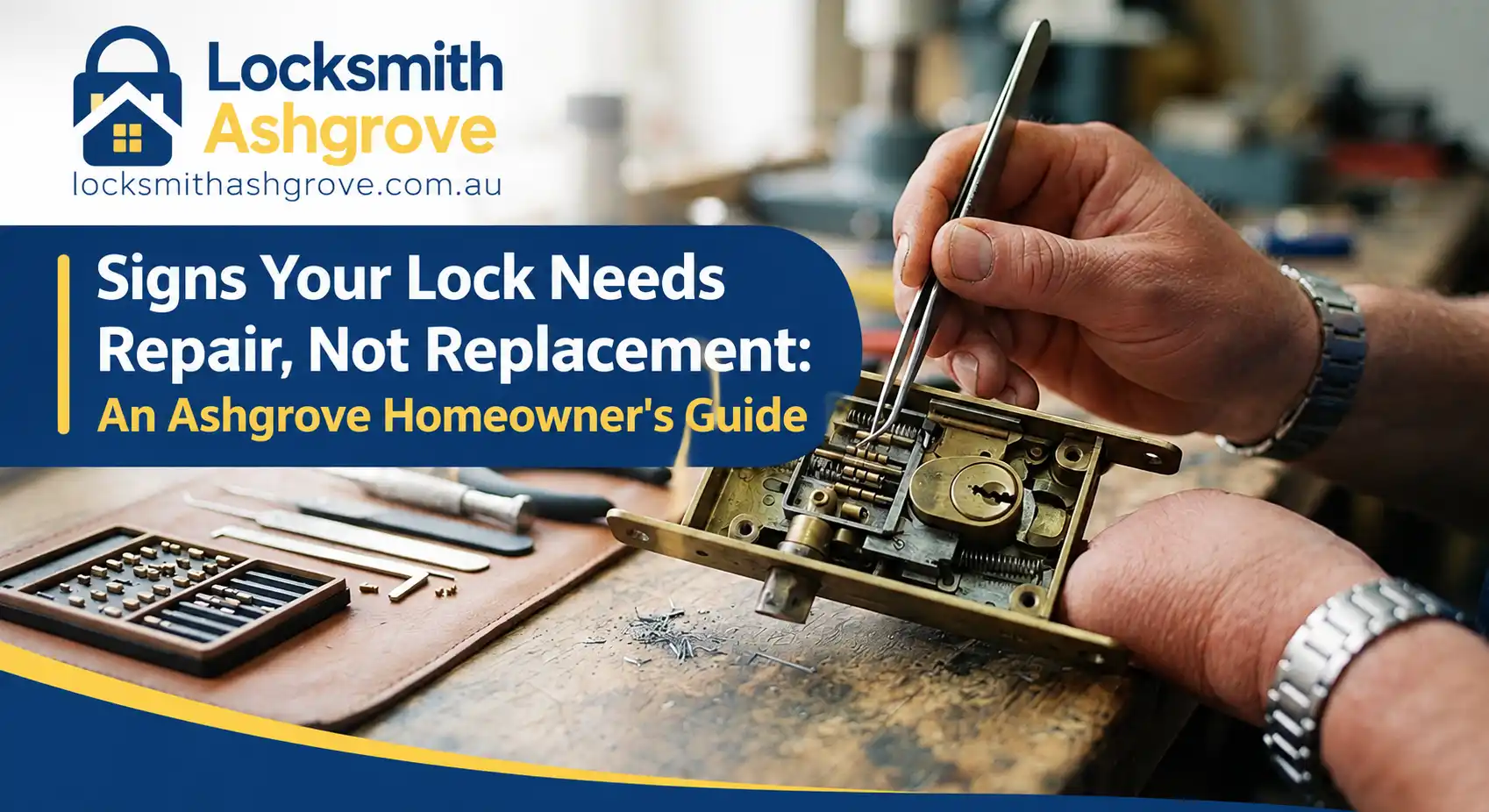
Not Every Faulty Lock Needs to Go
Understanding the signs your lock needs repair, rather than jumping straight to full replacement, can save you money and preserve hardware that’s often still perfectly sound underneath a minor fault. This is especially true across Ashgrove, where many homes still carry original or long-installed locks, including mortice hardware on older Queenslanders that isn’t always easy or necessary to replace outright.
It’s easy to assume that once a lock starts acting up, replacement is the only sensible option. In reality, most lock problems fall into a handful of common, fixable categories, and recognising which one you’re dealing with means you can make a properly informed decision rather than defaulting to the more expensive option out of uncertainty.
At Locksmith Ashgrove, a large share of our repair callouts turn out to be exactly that — repairs, not replacements. Here are the signs your lock needs repair rather than a full swap, and a few situations where replacement genuinely is the better call.
The Key Turns With Increasing Resistance, But Still Works
One of the clearest signs your lock needs repair rather than replacement is a key that still functions but requires more effort each time. This usually points to internal wear or a build-up of debris inside the cylinder, rather than a fundamentally broken mechanism. A locksmith can often clean, lubricate, and adjust the internal components to restore smooth operation without needing to replace the entire lock body.
The key distinction here is that the lock still ultimately does its job — it’s simply becoming less pleasant to use. Locks in this state respond well to proper servicing, and catching the issue at this stage, before it progresses to complete failure, is exactly when repair makes the most financial and practical sense.
Pro Tip:
Avoid spraying standard oil-based lubricants into a lock — they attract dust and grime over time. Ask your locksmith for a proper dry lubricant instead.
The Latch Doesn’t Retract Fully
If your door’s latch feels like it’s catching or not pulling back completely when you turn the handle, this is another situation among the clear signs your lock needs repair before you consider anything more drastic. Often this comes down to a misaligned strike plate, a slightly swollen door frame — common in Brisbane’s humid climate — or a worn spring inside the latch mechanism itself.
A locksmith can typically diagnose this quickly by checking whether the issue originates in the door alignment or the lock hardware itself. In most cases, adjusting the strike plate position or replacing a single worn spring resolves the problem entirely, without touching the rest of the lock.
“Nine times out of ten when someone tells us their latch is sticking, it’s a five-minute adjustment, not a new lock. We always check before recommending replacement.” — Locksmith Ashgrove
A Handle or Lever Feels Loose
A wobbly door handle or lever is one of the more visible signs your lock needs repair, and it’s also one of the easiest to fix. In the vast majority of cases, this comes down to loose mounting screws or a worn spindle connecting the handle to the internal mechanism — both straightforward repairs that don’t require replacing the lock case itself.
Left unaddressed for long enough, a loose handle can eventually wear the internal mechanism more seriously, since the extra movement puts uneven stress on components designed to operate along a fixed axis. Catching this early, while it’s still just a loose handle, is exactly the kind of minor repair that prevents a bigger, more expensive problem down the track.
Warning Sign:
If a loose handle is accompanied by a key that’s also becoming harder to turn, the two issues may be related — worth having both checked in the same visit.
The Lock Is Noisy But Otherwise Functional
A lock that’s started grinding, clicking unusually, or making noise it didn’t used to make is often signalling early internal wear — but noise alone, without an actual functional failure, is generally one of the clearer signs your lock needs repair rather than replacement. Catching a noisy lock early and having it serviced properly can prevent the wear from progressing to the point where it does eventually need full replacement.
This is particularly relevant for original mortice locks in Ashgrove’s Queenslander homes, where the mechanism sits inside the door itself and unusual noise is often the first indication of a lever or spring beginning to wear, well before the lock actually stops functioning.
Why Homeowners Often Assume the Worst
There’s a natural tendency to assume that once something mechanical starts misbehaving, it’s on its way to complete failure. This instinct makes sense for plenty of household items, but locks are actually a bit different — they’re relatively simple mechanisms with few moving parts, and most of those parts are designed to be individually serviceable rather than requiring the whole unit to be discarded at the first sign of trouble.
Part of the confusion also comes from how lock problems are marketed and discussed online. A lot of generic advice defaults to recommending replacement for almost any issue, partly because it’s a simpler, more universal answer than walking through the various signs your lock needs repair versus the signs it genuinely needs replacing. This isn’t necessarily bad advice for every situation, but it does mean homeowners often replace hardware that a straightforward service call could have fixed.
The Cost Difference Between Repair and Replacement
Beyond the mechanical considerations, there’s a practical cost dimension to this decision that’s worth being aware of. Repairing an isolated fault — a worn spring, a misaligned strike plate, a loose handle — is typically a faster, more contained job than removing an existing lock and fitting new hardware, particularly on older doors where the new lock may need to be matched carefully to existing holes and fittings.
This doesn’t mean repair is always the cheaper path overall. A lock nearing the end of its genuine service life might need repeated small repairs over time, eventually costing more than a single replacement would have. This is exactly why an honest, upfront assessment matters more than defaulting to either option automatically — the right call depends on the specific fault and the lock’s overall condition, not a blanket rule applied to every situation.
When Replacement Genuinely Is the Better Option
Not every lock issue falls into the repair category, and it’s worth being honest about when replacement is genuinely the right call. Visible rust or corrosion that’s compromised the internal mechanism, a lock that’s been forced or tampered with during an attempted break-in, or hardware that’s simply reached the end of its structural life after many years of heavy use are all situations where repair offers limited long-term value.
The general principle is that repair makes sense when the fault is isolated and mechanical — a worn spring, a misaligned latch, a loose handle. Replacement becomes the better option once the underlying structure of the lock itself has been compromised, whether through corrosion, physical damage, or age-related material failure that goes beyond what adjustment or cleaning can fix.
Getting an Honest Assessment
The challenge for most homeowners is that it’s genuinely difficult to tell the difference between a repairable fault and a lock that’s reached the end of its life, simply by looking at it or trying the key a few times. This is exactly where a proper inspection from an experienced locksmith earns its value — rather than guessing and either overpaying for an unnecessary replacement or underspending on a repair that won’t actually hold.
A locksmith who takes the time to actually diagnose the specific fault, rather than defaulting to whichever option is more profitable, is worth seeking out. Most of the signs your lock needs repair covered above are things a homeowner can genuinely notice themselves, which means you can often walk into that assessment with a reasonably informed idea of what’s likely going on.
Quick Checklist: Repair-Friendly Signs to Watch For
Run through these before assuming your lock needs full replacement.
- Key still works but needs more effort to turn — likely repairable
- Latch doesn’t retract fully but the lock otherwise functions — likely repairable
- Handle or lever feels loose but the lock still operates — likely repairable
- Lock makes noise but hasn’t actually failed — worth servicing before it worsens
- Visible rust, forced entry damage, or structural failure — likely needs replacement
Conclusion
Recognising the genuine signs your lock needs repair, rather than assuming every fault means a full replacement, saves money and preserves hardware that’s often still entirely serviceable. This is particularly worth understanding for Ashgrove homeowners with older or original locks, where a repair can maintain both the functionality and the character of hardware that’s been part of the home for decades.
The key is getting an honest, properly diagnosed answer rather than guessing. A lock that’s sticking, loose, or noisy isn’t automatically finished — in most cases, these are exactly the signs your lock needs repair, not the signs it needs replacing, and knowing the difference means you only pay for the work your lock actually needs.